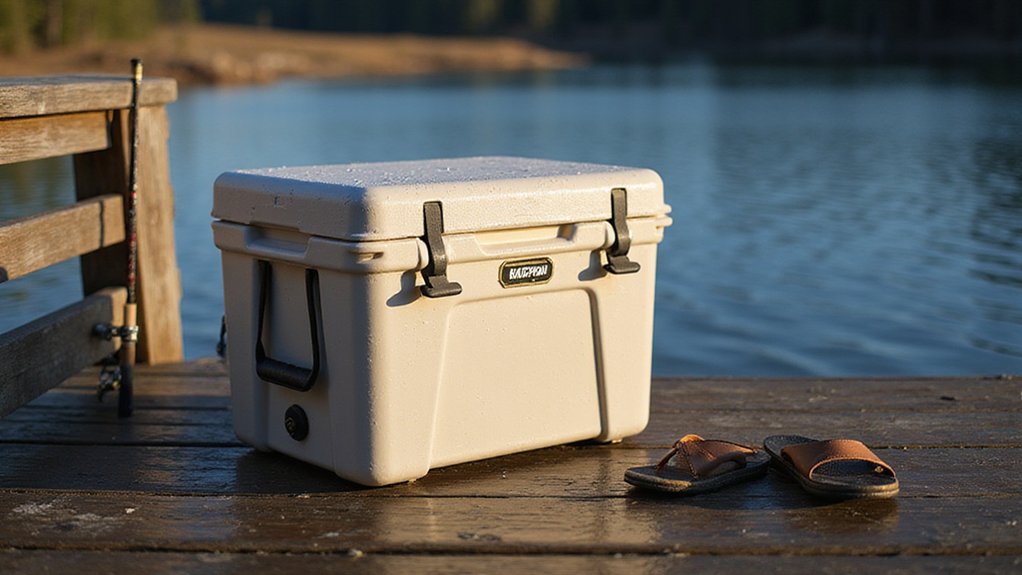
Wondering how long your YETI cooler can keep ice before it melts away? Typically, you can expect it to hold ice for three to five days with normal use.
But with some prep, you might stretch that beyond ten days. Factors like sun exposure and how often you open the lid play a big role.
Keep reading to discover how to maximize your cooler’s ice retention.
Real YETI Ice Life: 3–5 Days vs. 10+ Days
The actual ice life you get from a YETI cooler depends heavily on how you use it. For typical mixed use—storing both food and drinks with regular opening—you can expect 3 to 5 days of ice retention. Pre-chilling your cooler before loading it with ice and minimizing how often you open the lid will improve its efficiency. If you fill it completely with ice and keep it in the shade, you might see up to 7 to 10 days of ice life. Larger hard coolers tend to perform better than smaller ones, especially when packed solely with ice. For example, a 110-quart model filled with ice in a shaded environment could last beyond 10 days. However, soft coolers or smaller hard coolers are unlikely to reach those extended durations, especially if you access them frequently, keep warm contents inside, or expose them to direct sunlight. Additionally, maintaining your ice maker’s water line with regular deep-cleaning helps prevent mineral buildup that can affect ice quality. If you plan to bring such a cooler to a theme park, review park policies to avoid potential size restrictions or confiscation risks. For social gatherings, durable plastic cups offer a practical alternative to glassware that won’t shatter.
Why Won’t YETI Commit to One Ice Retention Number?
YETI does not commit to a single ice retention number because the actual time ice lasts depends on several factors beyond insulation technology. Instead of promising a fixed duration like 10 days, YETI emphasizes its advanced insulation features, such as PermaFrost™ Insulation and the ColdLock™ Gasket, which work together to maximize ice longevity. They recognize that the duration varies greatly based on the amount of ice used, the type of ice (crushed versus block), and external conditions like temperature and usage habits. Published claims are based on controlled tests, not real-world adventures, so your experience may differ. A similar principle applies when using a slushie machine, where the optimal ingredient ratios are crucial for achieving the proper frozen texture. By focusing on their technology rather than fixed promises, YETI aims to give you a reliable, high-performing cooler that adapts to your specific needs and environment. For comparison, nugget ice machines offer a consistently smaller ice form that melts faster than block ice in any cooler. Understanding that many paper cups are lined with a thin plastic layer that prevents composting is similarly essential, as this plastic lining inhibits breakdown just like crushed ice’s high surface area accelerates melting.
6 Ways Sun, Heat, and Openings Drain Your Ice Faster
Sun exposure can raise your cooler’s internal temperature by 10 to 15°F compared to shade. Dark-colored coolers absorb more heat, speeding up ice melting. When your cooler sits in direct sunlight, the increased heat accelerates the melting process. Proper placement in shaded areas helps keep the internal temperature lower, protecting your ice longer. For optimal insulation performance, you could also apply the same agitated cooling principle used in cocktail shakers to mix drinks, quickly circulating cold air around the contents. Additionally, using jello shot cups with lids can help maintain cold temperatures for individual servings. Regular cleaning of commercial ice machines prevents slime and bacteria that can also reduce cooling efficiency in stored ice.
How to Prep Your Cooler for Maximum Ice Performance
Pre-chilling your cooler for up to 24 hours with ice or frozen bottles is essential before you load it. A warm interior quickly steals cold from new ice, reducing overall ice lifespan. Just before loading, dump any meltwater to prevent mixing with fresh ice, which can cause a quicker warm-up. Keep your cooler indoors in a cool space during pre-chill, then move it to shade during use to maintain its cold temperature longer. Use strategic packing by loading only refrigerated or frozen items to lower the heat load, and fill all gaps with ice or frozen bottles to eliminate warm air pockets. Maintain a 2-to-1 ice-to-contents ratio for optimal performance. Tightly pack the cooler to prevent convection currents, which cause heat transfer. For serious cold storage, consider pairing your cooler with an under-counter ice maker that produces high-quality ice for consistent replenishment. Removing the pre-chill ice, adding new ice, and packing densely will maximize your cooler’s ice life, keeping your items cold for as long as possible. To put your ice needs in perspective, a standard red solo cup holds about 16 fluid ounces or 2 cups of ice. Standard ice packs typically last 24 to 48 hours in a well-insulated cooler, depending on external temperature and the quality of the ice.
Block Ice vs. Cubed: Which Ice Type Boosts Retention?
Block ice generally lasts longer than cubed ice because it has a smaller surface area, which slows down melting. In a typical test, block ice kept a cooler below 45°F for up to 92 hours, while cubed ice lasted about 85 hours. This makes block ice the better option for extended trips where long-lasting cold is a priority. A similar principle applies to a Hawthorne strainer, which uses a perforated cone to separate solids from liquids with minimal surface area exposure. For weddings, personalized wedding cups can also enhance the celebration while keeping drinks cool. When selecting ice, understanding jigger uses helps you measure the right amount for consistent cooling performance.
Cubed ice chills drinks faster due to its larger surface area, but it melts more quickly, reducing its overall longevity. Using a mix of both types lets you enjoy quick cooling at the start and sustained cold later. For multi-day adventures, block ice provides better retention; for shorter outings, cubed ice is ideal for rapid cooling.