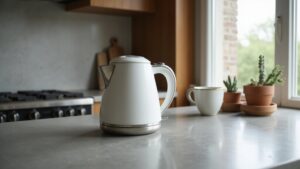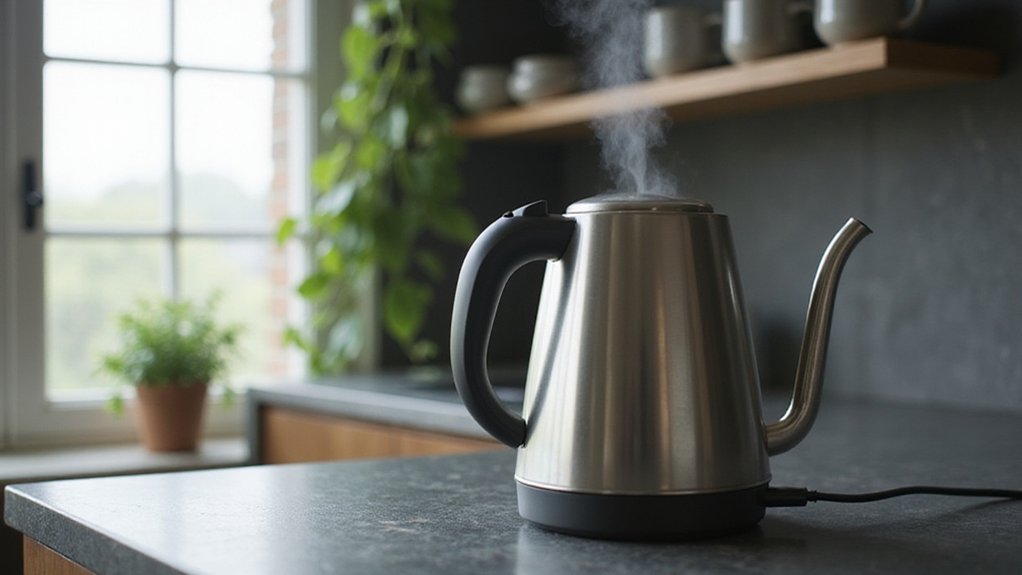
Ever wonder what happens inside your electric kettle from the moment you plug it in? It might seem simple, but a few clever mechanisms make boiling water quick and safe.
By the end of this, you’ll understand exactly how your kettle turns electricity into hot water efficiently and automatically.
Let’s dive into how this handy device works behind the scenes.
What Happens When You Plug In an Electric Kettle?
When you plug in an electric kettle, the outlet completes the electrical circuit, sending power to the kettle’s internal controls and heating element. However, the kettle won’t start heating until you flip the switch or press a button. The initial cord connection energizes the plug, cord, and base, establishing the pathway for electricity.
If the kettle is switched off, no power flows to the heating element, so no water heats up. Many simple kettles draw little to no power when idle, but models with indicator lights or smart functions may still consume standby electricity. Keeping the kettle plugged in prolongs exposure to outlet stress and increases the risk of faults, especially if left unattended for long periods. The Proctor Silex model features an illuminated on/off switch, which indicates it draws standby power when the switch is off but the plug remains connected. For users who also value protecting their surfaces, wood coasters provide stylish and effective drink protection to complement any countertop setup. Neglecting to clean your kettle regularly can lead to buildup that affects performance, much like how often you should clean a commercial ice machine to prevent scale and bacteria. For a consistently refreshing cold beverage, consider a machine that produces nugget ice for its chewable texture and rapid cooling.
For cordless models, power is supplied through contacts on the base once the kettle is seated. Unplugging the kettle regularly reduces the risk of electrical faults, which is particularly advisable for infrequent use to maintain safety and device longevity.
How Does the Heating Element Get Hot?
Once you switch on your kettle, the electrical circuit sends power directly to the heating element. This element, typically made from a nickel-chromium alloy like nichrome, heats through resistance heating. As electrons flow through the metal, they collide with its atoms, creating constant atomic vibrations—that friction transforms electrical energy into heat. The more resistant the material, the faster it heats up, following the equation \(Q = I^2Rt\). Because the element’s small size concentrates this energy, its temperature rises quickly. At this stage, no water has touched the element, and it remains insulated by materials like magnesium oxide. For a comparison of similar high-heat kitchen appliances, you can see the best countertop ice makers reviewed for your kitchen. This is why the heating element gets hot long before the water does. Many modern kitchen appliances, such as water coolers with ice makers, utilize similar resistance heating principles for rapid water temperature control. A similar principle governs the heating of antique coffee grinders that rely on friction rather than electric resistance.
How Does Heat Transfer From the Element to the Water?
Heat transfers from the heating element to the water primarily through conduction. The element sits at the kettle’s base, so water molecules that come into direct contact with it quickly absorb thermal energy. This process, known as thermal conduction, allows heat to move rapidly from the hotter element into the cooler water. As a result, water near the bottom heats first because that’s where the energy enters. The energized molecules then transfer energy through molecular collisions, passing heat outward through the liquid. These collisions accelerate the temperature increase, distributing warmth throughout the kettle. The design of the heating element enhances this process: exposed coils facilitate direct heat transfer, while concealed elements rely on the metal surface to conduct heat efficiently. However, buildup of scale on the heating surface can act as a barrier, impeding heat transfer, so keeping the surface clean helps ensure optimal performance. For making shaken espresso, best cocktail shakers enhance the mixing and cooling process when combined with the hot water and coffee.
How Do Convection Currents Speed Up Boiling?
Convection currents speed up boiling by continuously moving thermal energy from the bottom of the water to the top. When water near the heating element warms first, it expands, becomes less dense, and rises toward the surface. Cooler, denser water then sinks to replace it, establishing convection patterns. This circulation distributes heat more evenly throughout the water, preventing temperature stratification where the top remains cooler. As these convection patterns strengthen with increasing temperature differences, heat is transferred upward more rapidly. This process ensures warm water continuously delivers thermal energy to the surface, helping the water reach boiling point faster and more evenly. For example, knowing that 16 ounces equals 2 cups helps in measuring the exact water volume for electric kettle use. Using a cup with a straw and lid can help keep hot beverages insulated while the kettle boils. Selecting a glass tumbler with straw ensures the beverage container is both durable and easy to clean during daily use.
How Does Steam Trigger the Kettle’s Automatic Shut-Off?
When the hot steam contacts the bimetal element inside the kettle, it causes the two different metals to expand at different rates. This differential expansion makes the metal disk bend or snap suddenly, creating a mechanical force. That force then moves a latch connected to a mechanical switch. The switch’s electrical contacts quickly separate, cutting power to the heating element. You will hear a distinct “click” as the circuit opens. The entire system relies solely on mechanical parts and reacts directly to steam, not the water’s temperature or simmering condition, ensuring the kettle turns off precisely at boiling point. This process uses a bimetallic plate with two metals expanding at different rates. This same principle of precise mechanical reaction is also used in some top plastic pitchers to ensure reliable lid closure and prevent spills. Many manufacturers also apply this reliable steam-sensing design to craft personalized wedding cups for unique party favors. A similar focus on durable temperature control can be found in best coffee brewers with thermal carafes for consistent results.
What Safety Features Prevent Overheating and Dry Boiling?
Electric kettles include several safety features that prevent overheating and dry boiling effectively. Boil-dry protection automatically cuts power if the kettle detects no water, stopping the heating element from operating in air and reducing the risk of fire or damage. An overheat cut-out thermostat, often utilizing a bimetallic disk, triggers and opens the circuit if the temperature exceeds a safe limit, serving as a backup safety measure when water levels are low. Some models combine a water-level sensor with a temperature sensor for more reliable shutdown; this sensor detects insufficient water before severe overheating occurs. Control circuitry constantly compares sensor signals and disconnects power when preset thresholds are exceeded. Many kettles then require a cooling period before they can be reset, limiting the chance of immediate re-overheating and ensuring ongoing safety during use.
Is an Electric Kettle More Efficient Than a Stovetop?
An electric kettle is more efficient than a stovetop kettle. It directly heats the water with about 80 to 85 percent of the energy going into boiling, whereas gas stoves convert only about 30 to 40 percent of fuel into heat that warms the water. Because of this, an electric kettle consumes less energy and boils water faster—often in 2 to 4 minutes—compared to 5 to 10 minutes on a stovetop. For example, boiling a liter of water uses approximately 0.094 kilowatt-hours (kWh) with an electric kettle, whereas a gas stovetop requires around 0.18 kWh equivalent. This efficiency translates into saving both energy and time during boiling, making electric kettles a more eco-friendly choice. By contrast, nugget ice makers rely on a compressor and auger system to shave and freeze ice into soft, chewable chips. For a similar principle in cooling beverages, top ice buckets with champagne can maintain optimal temperature for hours.