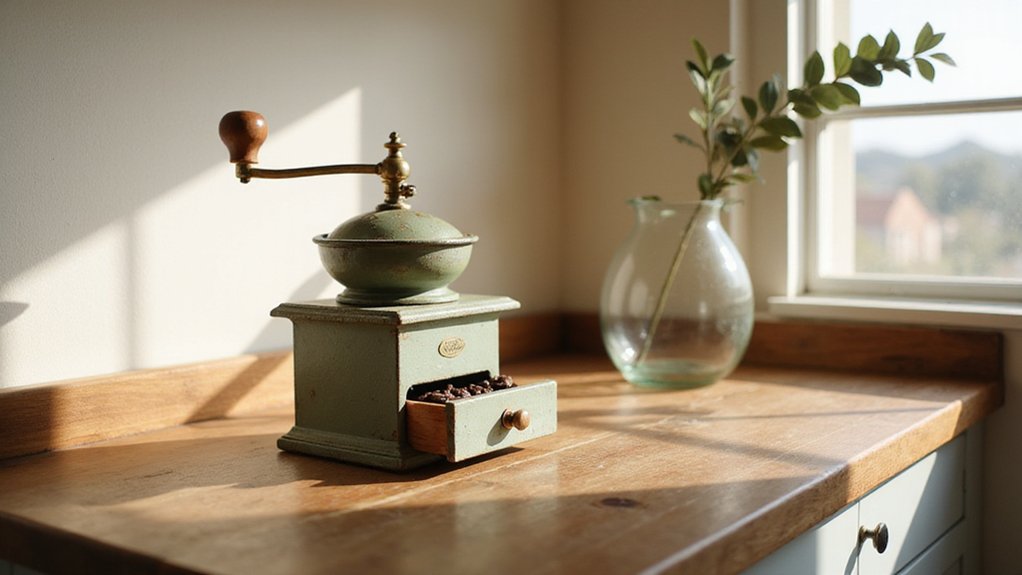
Wondering how to figure out the age and worth of your antique coffee grinder? The key lies in inspecting marks, hardware, and style to narrow down its vintage and value.
With a few simple steps, you can start uncovering its story and know what it’s truly worth. Keep reading for the full guide to dating and appraising your grinder.
What Your Antique Coffee Grinder’s Maker Marks Reveal
Maker marks on your antique coffee grinder reveal its age and origin with remarkable precision. These stamps, engravings, or cast letters are typically found on the base plate, crank arm, hopper lid, or back of ceramic wall grinders. To date your piece, start by identifying the company name and comparing it to documented brand histories. Logo variations can also indicate different production periods; for example, a Peugeot Frères mark featuring a detailed lion was used before the logo simplified in later years. Be aware that raised cast letters often become obscured by paint or rust on older cast-iron models, so careful cleaning may be necessary to see them clearly. Patent dates stamped alongside maker marks provide the earliest possible production year, while city or country names point to the grinder’s manufacturing location. Clear, well-preserved marks can increase collector value, but even faint or faded marks can reveal important clues about your antique’s provenance. For those displaying their collection, choosing a beverage dispenser with stand can similarly enhance presentation and functionality. The same principle of prioritizing quality and value applies when selecting a modern tumbler with a handle for daily use. When evaluating a coffee brewer for modern use, looking for a thermal carafe ensures the beverage stays hot without a heating plate.
Nails, Screws, and Dovetails: How Construction Details Reveal the Decade
The nails, screws, and dovetails you see can tell you the age of your piece with surprising accuracy. Hand-forged nails with irregular heads typically date before 1790, as they were made by blacksmiths before the advent of industrial manufacturing. Between 1790 and 1890, cut nails—square, uniform, and machine-made—became common.
Your metal joinery offers clues too. Hand-cut dovetails, often with slightly uneven angles, indicate a construction date before about 1860. After that, machine-cut dovetails with precise, clean edges start to appear, marking newer craftsmanship. Examining screw slots can further narrow down the age. Off-center or irregular slots suggest screws made before 1850 by hand, whereas machine-cut screws, with symmetrical slot patterns, are usually post-1850.
If you find Phillips-head screws, they likely relate to repairs made after 1936, when this design was introduced. Keep in mind, however, that if different fasteners show conflicting dates, your piece was probably repaired or modified over time. Therefore, matching hardware across joints—like all nails or all screws—helps pinpoint a more accurate decade. Remember, a single later screw or nail doesn’t necessarily date the entire piece but comparing all these details together gives you the best estimate. Like antique grinders, regular cleaning of a gooseneck kettle will preserve its function and value over time. For those seeking a modern comparison, best juice dispensers also rely on straightforward construction clues to indicate quality and era. Even for outdoor appliances, stainless steel durability is a key indicator of quality and longevity.
The 4 Major Style Periods From 1820 to 1950 (And How to Spot Each)
Antique coffee grinders can be categorized into five major style periods, each with distinctive features that help you identify their age. Starting with pre-industrial wooden box mills (1820–1850), you should look for dovetailed joints and hand-forged iron components. These are typical of early manufacturing, where local smiths sourced materials and crafted each piece by hand. The joints reveal precise woodworking techniques, while the ironwork shows signs of hand-forging, such as uneven hammer marks. For modern equivalents, consider nugget ice makers if you prefer crushed ice for your cold brew. If you are hosting a party, you might also want to serve your cold brew from a top-rated punch bowl with matching glasses for an elegant presentation. Additionally, maintaining your ice maker with a simple cleaning routine ensures your cold brew stays fresh and free of mineral buildup.
Moving to early cast-iron table mills (1850–1880), expect heavier bodies combined with twin grinding wheels. These models often feature visible brazed cracks or repair lines, indicating early repair techniques when castings cracked or broke. The design tends to be more utilitarian, with less ornamentation but sturdier construction suited for increased production.
Victorian wall mills (1880–1910) are noted for their ornate branding and decorative brackets. Expect intricate castings and detailed metalwork, often with fancy flourishes that reflect the era’s appreciation for decoration. These mills were not just functional but also intended as statement pieces in kitchens or stores.
Mass-production models (1910–1930) simplify earlier lines, featuring glass hoppers for coffee beans and streamline shapes. You’ll notice less elaborate metalwork and more standardized, modular designs copying industrial manufacturing processes. These are easier to spot due to their minimal decoration and practical form.
Finally, late vintage grinders (1930–1950) include Bakelite parts and sleek Art Deco shapes. The use of Bakelite, a plastic popular in mid-century products, is a quick indicator of this period. The design focuses on modern aesthetics—geometric shapes and smooth curves—distinct from earlier ornate styles. Recognizing these features allows you to quickly date your grinder within this broad timeline.
Value Ranges From $20 Finds to $5,000+ Treasures
Values for antique grinders range widely, from $20 for common finds to over $10,000 for rare, museum-quality pieces. Simple lap or box grinders often sell for $20 to $100, though many are damaged or incomplete. Restored examples from well-known makers typically fetch between $40 and $150. Mid-tier cast-iron models, especially wall-mounted or table styles, tend to range from $150 to $600. Ornate canister-style grinders with original paint and intricate detail can reach $1,000. The most valuable pieces—featuring rare maker marks or fine craftsmanship—can command thousands of dollars. An example is an entire Enterprise No. 12 with original paint and a brass eagle finial, which can sell for $5,000 to $7,500 at auction. At the top end, museum-quality or highly rare pieces have sold for $10,000 to $15,000 or more.
The 4 Factors That Actually Drive Antique Coffee Grinder Value
The four key factors that drive antique coffee grinder value are maker prestige, condition, originality, and rarity.
First, the maker’s reputation significantly influences price. Collectors prefer grinders from well-known European or American brands that have clear, identifiable stamps. These prestigious makers often command a premium over generic or unmarked models.
Condition is a critical component. Fully functional grinders with smooth cranks and minimal wear fetch higher prices. Heavy rust, seized mechanisms, or damage can drastically reduce value. Keep the grinder clean and ensure it operates smoothly.
Originality is equally important. Collectors value complete sets with original drawers, lids, and maintained patina. Replacing parts with non-original components or restoring the grinder with married or mixed parts diminishes its desirability. Those with an untouched, authentic appearance are more sought after.
Finally, rarity drives prices higher. Models from the 19th century, especially limited editions or ornate Victorian styles, tend to be more valuable. Rarer items stand out in collections and often attract premium bids. Heavy restoration or repainting typically lowers a grinder’s value, so preservation of originality is key. For context, a similar mechanical device might suffer from loud vibrating parts if ice jams the auger, which can be fixed by clearing the hopper.
Focusing on these four factors will help you recognize genuine antiques worth pursuing and avoid overpaying for less desirable pieces.
Snap Photos, Check the Hardware: How to Appraise Your Grinder
Once you’ve gathered your photos and checked the hardware, you’re ready to start a structured appraisal that reveals your grinder’s true worth. Take photos of all sides using diffuse natural light. This prevents glare and highlights the vintage paint and true brass tones. Look for slotted screws—these suggest the grinder is pre-1936, as Phillips head screws indicate repair work after that date.
Examine nail types: square cut nails point to pre-1890, machine-cut nails suggest a period between 1890 and 1910, and wire nails are more modern. Inspect the brass for oxidation—a brown-honey patina with green verdigris signals genuine age. Bright, shiny brass often indicates recent polishing or replacement. Check the edges and knobs for consistent wear; this supports originality. Confirm that the hopper, crank, and drawer are all present, since missing parts or cracks lower the value. Consider the type of grinder, as burr vs. blade models differ significantly in age and collectibility. For comparing features, review the quality and value ratings often given to similarly collectible kitchen tools. A water dispenser with stand, by contrast, receives ratings based on hydration performance and durability.
Start your appraisal by considering the overall form, then move to marks, hardware, finish, and internal components. Following this workflow will help you accurately determine your grinder’s age and market value.
Stuck on an Unmarked Grinder? Cross-Check These Catalog Archives
If your grinder lacks any maker’s mark, you can still narrow down its origin by cross-checking several catalog archives. Start with the Association of Coffee Mill Enthusiasts (ACME) archive, which serves as a central repository for historical manufacturing data. This resource provides detailed information about models, materials, and production years that can help distinguish your grinder from others. For instance, knowing the equivalent of 16 ounces in cups can similarly help you interpret historical recipes or coffee-to-water ratios listed in old literature.
Next, consult the MacMillan Index, which spans over 1,300 pages cataloging model variations despite often inconsistent branding. Comparing your grinder’s hardware and styling to entries in this index can reveal subtle differences that point to specific manufacturers or eras. When considering cold storage of coffee beans, choosing a cooler with high-performance ice packs ensures freshness and protects historical flavor profiles.
Peugeot’s catalog plates, covering the years from 1840 to 1975, show logo modifications over time. Analyzing these changes allows you to match your grinder’s logo and packaging to a particular timeframe.
Enterprise Manufacturing catalogs from 1904 and 1911 document model numbers and dimensions, giving you concrete data points to identify similar hardware and estimate production dates.
Finally, triangulate your findings with auction archives and museum records such as those maintained by the Smithsonian. These archives offer photographs and detailed descriptions of original pieces, helping you differentiate between authentic manufacturing and later reproductions. By comparing your grinder’s hardware style to these documented examples, you can pinpoint its maker, type, and era even without a visible stamp. For example, the same method of cross-checking catalog archives used for antique grinders is akin to verifying a tool’s design against historical records to ensure you apply the right technique, like gentle pressure when muddling without a muddler.