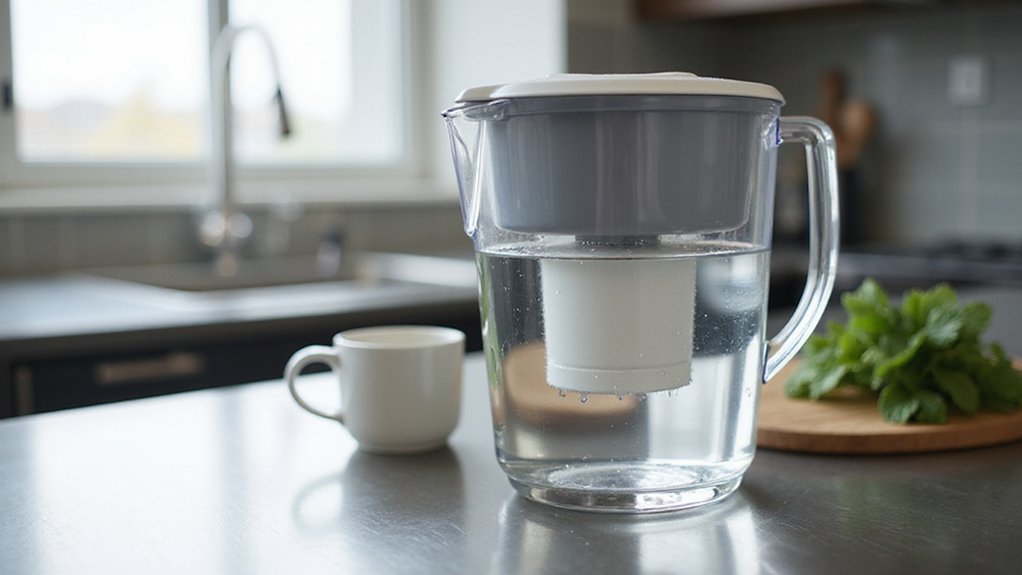
If you’re trying to find the water filter pitcher that removes the most contaminants, ZeroWater stands out. It reduces total dissolved solids to zero, something no other pitcher can do.
Plus, it’s certified by NSF standards for removing lead, mercury, chromium, and PFAS.
The full details below will help you choose the right filter for your water.
Which Pitcher Removes the Most Contaminants in Lab Tests?
Which Water Filter Pitcher Removes the Most Contaminants?
Which Pitcher Removes the Most Contaminants in Lab Tests?
The pitcher that removes the most contaminants in lab tests is Clearly Filtered. It achieves a 100% reduction in over 365 contaminants, including fluoride and uranium. AquaTru also excels, hitting 100% removal on every tested health-related contaminant in their lab panel, but Clearly Filtered offers a broader range of protection. Waterdrop matches these standards by removing all dangerous contaminants such as lead and barium according to 2026 testing. These results mean you’re choosing pitchers that are backed by third-party data, ensuring you’re getting effective contaminant removal rather than just marketing claims. For maximum protection, these three pitchers stand out by consistently eliminating the widest array of harmful substances. For everyday use, a jigger acts as a measuring tool in cocktail making but is not tested for contaminant removal. By contrast, if you are brewing large batches of coffee, a 30 cup coffee urn requires careful coffee-to-water ratios to avoid bitterness. Understanding the exact gallon conversion helps when you need to fill a pitcher with 16 oz cups for batch testing.
Why ZeroWater’s 100% Removal Rate Beats Every Other Pitcher
ZeroWater’s 100% removal rate refers specifically to its ability to reduce the total dissolved solids (TDS) to zero, a feat that no standard carbon pitcher can achieve. This is possible because of its aggressive ion-exchange process, which can eliminate virtually all dissolved solids, including metals like lead, chromium, and mercury, as confirmed in lab tests. However, it’s important to understand the limits. ZeroWater’s certification covers NSF/ANSI 42, 53, and 401, which target specific contaminants such as chlorine, lead, and certain PFAS compounds. It does not ensure removal of bacteria, chloramines, or all volatile organic compounds (VOCs). For those who also enjoy fresh-tasting water from their appliances, pairing this with a nugget ice maker helps maintain a perfect chill. Understanding the different types of descaling solutions can help you maintain such appliances by preventing mineral buildup. So, while ZeroWater outperforms other pitchers in reducing dissolved solids and certain metals, it doesn’t guarantee complete elimination of every possible contaminant from your tap water. For a similarly fresh-tasting result, you can apply step-by-step cleaning methods to your ice maker for ongoing maintenance.
The Pitcher That Claims 365+ Contaminants: Does Clearly Filtered Deliver?
Clearly Filtered claims to remove over 365 contaminants, but its official NSF certifications cover only NSF/ANSI 42 (chlorine taste and odor) and 372 (lead-free materials). This means it is certified only for these specific standards and not for a broad range of water safety concerns. The 365+ figure reflects lab-tested removal capability, not formal certification standards. You rely on internal testing data to judge its effectiveness against fluoride, uranium, and PFAS. While the brand emphasizes its ability to filter a wide variety of contaminants—including pesticides, heavy metals, and pharmaceuticals—these claims are not independently verified through third-party certification. A key difference is that a pitcher’s filtration requires regular cobbler shaker maintenance to avoid channeling, whereas a simple pour-through design has fewer moving parts to fail. To prevent channeling and clogs, you should also clean and maintain your nugget ice maker with regular descaling to stop mineral buildup. Overall, you get strong performance on many common pollutants, but the broader contaminant coverage is based on internal results rather than official certification. In contrast, an electric tea kettle offers no filtration at all, so removing contaminants depends entirely on the water source or a separate filtration device.
ZeroWater’s Certifications: Why Lab Results Match the Marketing Claims
ZeroWater’s certifications are precisely what ensure the lab results match the marketing claims. They specify testing standards like NSF/ANSI 42, 53, and 401, so you know exactly which contaminants are evaluated. These standards typically cover lead, mercury, chromium, and PFAS, although not every possible impurity. Independent laboratories verify the same list through their testing, confirming reductions such as 99% arsenic removal or non-detect results for nine specific impurities. This alignment guarantees that the claims on the brochure reflect actual test outcomes, avoiding vague promises. Each reduction is tied to a certified standard, providing clarity and confidence that what ZeroWater promises matches what your water test reveals—no surprises, just reliable results. Unlike ice retention in coolers, which varies with ambient temperature and cooler model, water filter pitcher certifications are fixed to specific lab protocols. For a similar commitment to verified performance, look at how thermal carafe brewers are reviewed based on quality and independent testing standards.
How to Decide Between Maximum Removal and Broadest Contaminant Coverage
Choosing between maximum removal and broadest contaminant coverage depends on the specific contaminants in your water. If lead or PFAS is your main concern, prioritize filters with high contaminant specificity, such as those certified under NSF/ANSI 53 or PFAS standards. These filters excel at removing that particular target but are less effective against pharmaceuticals or volatile organic compounds (VOCs).
Conversely, if your water contains a mix of chlorine, lead, and emerging trace chemicals, opt for filters with broad contaminant coverage certified under standards 42, 53, and 401. This approach provides a wider range of filtration but often reduces filter lifespan, meaning you’ll need to replace cartridges more frequently.
Start by checking your local water report to identify prevalent contaminants. Matching your chosen filter’s certified claims to the actual contaminants in your water makes it easier to weigh the trade-offs and select the most effective option for your needs.